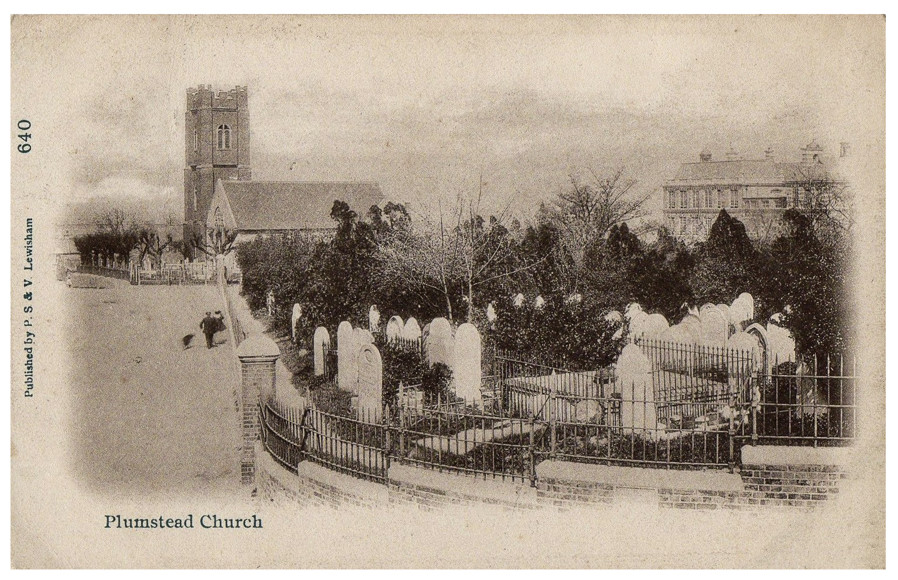





History
HIGH STREET SITE
Bannockburn Primary School (High Street) – A Potted History (1893 - 1993)
Originally High Street School, Plumstead, Bannockburn Primary School was opened on 5th January 1893, by J R Diggle, Esq. (Chairman of the London School Board) as separate Boys and Girls Elementary Schools (7 – 14 years) and a Mixed Infants School (5 – 7 years).
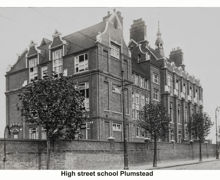
High Street site as it originally looked when first built
The school opened for children on the following Monday 9th January 1893. Children entering the Elementary Schools were placed in Standard I or Standard II, according to their ability.
The school was built for 850 children and, by the end of the year, approximately 720 pupils were on the roll of the Elementary Schools alone. A decision was made the following year to extend the school, to accommodate up to an additional 400 pupils. The extension was built over arches, thereby incorporating a covered playground.
Attendance was very poor – reasons being diseases, many of which have either been eradicated or are rare these days (small pox, quinsies, diphtheria, erysipelas, tuberculosis), the Sanger’s Circus parade, the Queen’s Birthday (for which the Arsenal – where many of the children’s fathers worked – would close), hop-picking in Kent, “helping mother” (after the birth of a sibling) and chilblains or “no boots” during freezing and snowy weather.
Bare-footed children in Plumstead were not unusual and parents really had to choose between providing boots for and feeding their children. The school received donations of boots and clothes from businesses, charities and the Plumstead Relief Society.
During the first few months that the school was opened, workmen had to be called in because windows did not fit properly and the school was draughty, cold and suffering from leaks.
The right to use corporal punishment was delegated to teachers in writing by the School Board – one deputy headteacher refused this right.
There were very few teachers in those days – for instance, in the boys’ elementary school, there were only five to start with (in addition to the headteacher) – so classes were very large, consisting of about 60 children in each. This meant that the school had to close on the occasion of a school trip – to the zoo, for instance.
Schools received funding from the Government based on day-to-day attendance, so both the school and the London School Board introduced a variety of schemes to encourage attendance. Children who attended school every day were rewarded with extended playtimes and early hometime on a Friday! The Board awarded medals to children who had both 100% perfect attendance records and had also displayed impeccable behaviour, typically by Mr Dawson, who was Chairman of the School Managers.
At Christmas, the boys watched a “Magic Lantern” (slide projector) show and some of the girls were invited as a reward for good attendance. Girls who received ten red marks during the week were rewarded on Friday afternoons with a free play session in the hall for fifteen minutes. Subjects taught to the boys were Scripture (RE), Mental and Written Arithmetic, Reading, Writing (Composition and Dictation); Geography, Elementary Science, Singing, Drawing, PE, Maps, Recitation and Mechanics.
The Girls did not have formal lessons in Science nor mechanics. Instead, they did Sewing, Laundry and Domestic Economy – in which the female teachers took the opportunity to teach as much Science as possible – evaporation/condensation, how coal is formed, etc.
During the Second World War, children and teachers were evacuated to Kent. The school was used as a rest centre for people whose houses had been bombed or who lived in streets awaiting the removal of unexploded bombs. The Rest Centre was very crowded, as it catered for people from both sides of the River. The basement was used as an Air Raid Shelter – the walls were reinforced with sandbags and the windows were bricked up.
On the drizzly night of 19th April 1941, during London’s 545th air raid, a fireman and a civilian were killed in a blaze which destroyed the top floor and attic. The above picture, showing the war-damaged building, was taken in 1955, ten years after the War!
By 1960, the upper levels had been removed and the remainder of the building adapted. Most of the rooms under the arches were used as playground shelters.
The end of the War saw many changes, not just to the structure of the school building, but to the national education system.
Plumstead High Street School became Bannockburn Junior Mixed and Infants School, later Bannockburn Primary School, incorporating nursery classes and catering for children from 3 – 11 years. Children now attended Grammar or Secondary Modern schools at 11 or the Polytechnic School at 13.
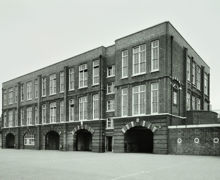
High St site viewed from the playground
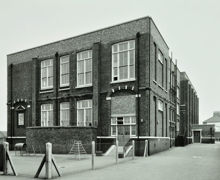
High St site view from Reception playground
The school leaving age was raised to 15. There have been many changes since, including the introduction of the National Curriculum in the 1990s. A major difference since the 1890s is the use of communication technology.
Bannockburn celebrated its Centenary in 1993, with the whole school being transformed, so that the children could learn about life in Victorian times.


manor way site
A Brief History of Bannockburn Primary - Church Manor Way Site
The Birth of the School
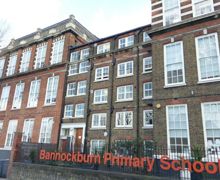 The current building at the Church Manor Way Site was opened by the London School Board on 24th August 1903. It comprised a mixed Senior Department (for 276 children); a mixed Junior Department (for 276 children) and an Infant Department for 278 children.
The headteachers were Mr Ellis Smith (salary £245 p.a.), Mrs Mary Ann Phillips Smith (salary £186 p.a.) and Mrs Amy Allport (salary £186 p.a.), respectively.
The headteachers were assisted by five class teachers (salaries of £90 p.a.). The school caretaker was Mr Richard Albert Jones. Mr Jones and his family lived on site in the school house, which is now where The Lodge is located.
The Early Years
A year after opening, the school managers (governors) reported that work was “undertaken with vigour” and that importance was placed on both work and play. There was a dedicated room for winter “lantern lectures” (slide shows) and there were football and cricket clubs.
Special interest was placed on the garden in the playground (which was popular with the children) - in which flowers were grown for drawing lessons – and nature lessons were conducted in Bostall Woods. There were several excursions to local places of interest.
Parents were invited, at regular intervals, to visit the school during lesson-time. The parents appreciated this privilege and the results were “pleasing and instructive”. The halls were used for P.E. and singing. The children were encouraged to save and the school bank was already prosperous.
The Museum (located above Plumstead Public Library) was a source of interest and instruction.
In the Infant Department, children who attended punctually and regularly were rewarded with an armband, and the class with the best attendance each week held a flag. Reports from LCC Inspectors in coming years were in the same vain. They expressed satisfaction at the value placed on play, music and dancing and the “natural, frank and individual” personalities of the children.
At junior level, the curriculum forced an effective bridge between the Infant and Senior Departments. There were plenty 1901 Census - Schoolkeeper School Log Book of opportunities for “doing” – for example, the children were encouraged to dramatise history and stories to inform their written work – which was also accompanied by illustrations of high standard.
The senior girls attended the Laundry Centre at Plumstead High Street School. From 1913, children were selected to attend the Woolwich Evening Play Centre.
By 1915, the girls and boys in the top class were taught separately, and both Church Manor Way and Plumstead High Street were feeder schools for Wickham Lane Secondary.
First World War
The LCC Inspection in 1915 brought special praise to the school: “The special difficulties of the moment are particularly manifest in Woolwich (there would have been a huge increase in the size of the population due to the massive numbers of employees required to work at the Royal Arsenal and conscripted soldiers being trained to the various barracks located around the town), and the continued strain to which the teachers and children are subject is an important factor in school life. The work in this department has suffered much less than might have been expected and much credit is due to the member of the staff for their self-possession and cheerfulness under trying conditions.”
During the early part of 1915, Church Manor Way and Plumstead High Street sites were alternately occupied by the army – meaning that both sets of children were taught in shifts at whichever of the schools remained open for lessons. There was less emphasis on formal treatment of lessons, such as Grammar, and greater emphasis applied to individual effort, independence, private research and diligent follow-up to feedback marking.
Specialisation in subjects was being introduced – for instance, there were History and Geography teachers in the Senior Department.
The value of practical work was still recognised, particularly in relation to Gardening.
The First Reorganisation
At the end of October 1926, the two schools were re-organised. Plumstead High Street became a mixed Senior School (having previously accommodated separate Girls and Boys Elementary Schools). Church Manor Way, on the other hand, now contained separate Boys’ and Girls’ Junior Schools. In addition, Church Manor Way School was used in the evening by the Woolwich Adult Education Institute.
The head teachers of the various new schools were keen to maintain the link, as a natural evolution of the re-organisation as they recognised that they had a common aim. Working as a team, the junior curriculum informed the senior curriculum. The head teachers met frequently, with the Headteacher of Plumstead High Street School effectively acting as an executive head teacher. This view was supported by LCC inspectors, and it was even planned that the schools would be bound by a common name.
The Second World War
The entire Church Manor Way School, both pupils and staff, were evacuated to Maidstone in Kent.
After the Second World War
Another reorganisation – the school became a girls’ Secondary Modern, concentrating on vocational skills – indeed, there were now two housecraft centres in separate buildings, including a flat! A commercial course was introduced in 1956, which was very popular. This was for one year, with an option to do two years by staying on at school until 16 years old.
The classes were streamed and girls in the top streams were taught French and there were school journeys to Paris. Needlework played an important part in the senior years, for girls intending to work in the “rag trade”.
In 1957, one of the ground floor classrooms was converted to a science laboratory. Half the girls in the first three years took general science lessons, with just a handful continuing at senior level. The other half of the younger girls did gardening in the still-extensive garden, growing flowers, vegetables, soft fruits and salads.
Although not offering ‘O’ Levels, inspectors observed that more girls were staying on for the extra year and more were entering skilled employment afterwards.
Amalgamation
The London School Plan had envisaged a comprehensive system, but was unable to afford it at the time. In 1967, three local girls’ secondary schools – Kings Warren Grammar School (the “Brown School” due to the brown uniforms), Waverley School (another Secondary Modern for girls which did offer ‘O’ Levels) and Church Manor Way amalgamated to form Plumstead Manor Comprehensive School on the site of the Kings Warren and Waverley Schools.
More Changes
Subsequently, the school opened as Churchfield Secondary School for boys and girls with moderate learning needs. Churchfield moved to Greenwich in 2003, after which the building was used as an annexe by the Greenwich Pupil Referral Unit.
Bannockburn arrives (again)
The rapidly increasing population in Plumstead and surrounding areas has led to a revision, again, of school provision in Royal Greenwich Borough. The building and grounds at Bannockburn Primary School, unable to match demand meant, inevitably, an expansion: into the Church Manor Way site in 2012 – with the official opening in May 2013. The current split is Reception and Key Stage 1 classes at the High Street and Nursery and Key Stage 2 classes at Church Manor Way.